
Peritoneal Dialysis Simulator
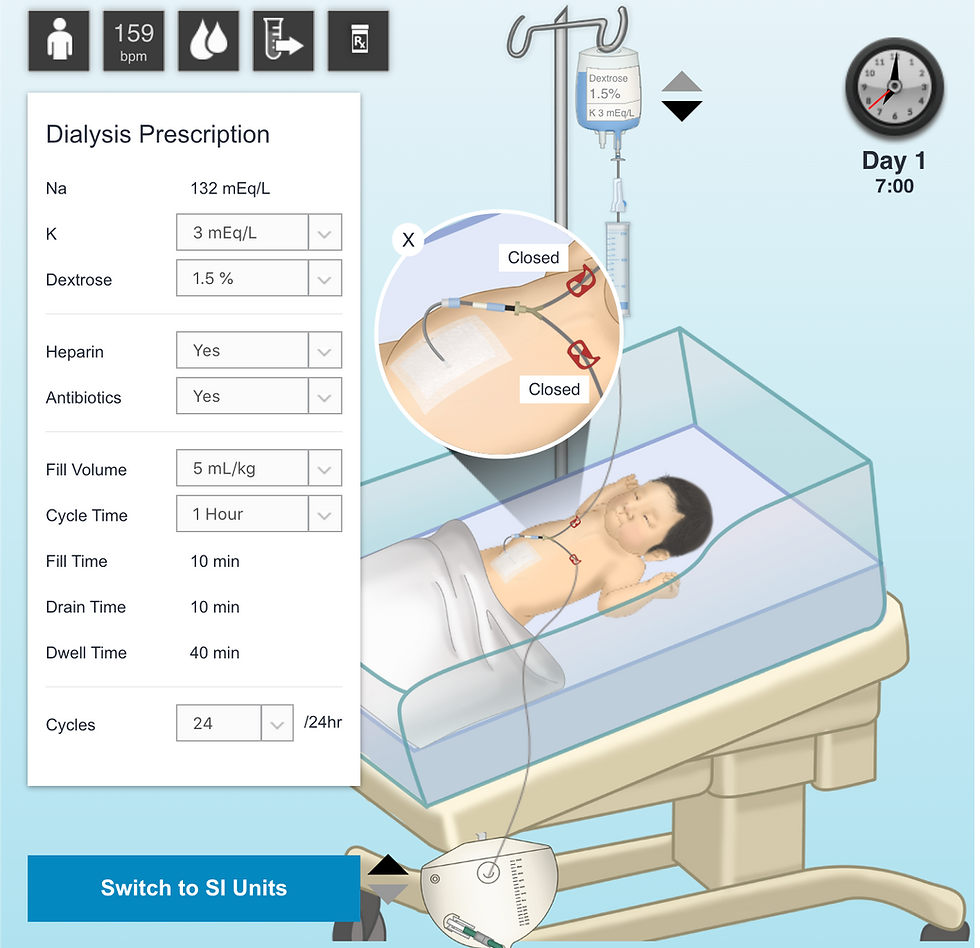
The peritoneal dialysis simulator offers training on the fundamentals of managing a child receiving peritoneal dialysis, including assessment of patient and dialysate; monitoring and responding to patient variables and laboratory results; and identifying complications from device manipulations.
2.5 hours
Initial Publication: January 2016
Last Updated: October 2020
Citation
Olszewski AE, Stein D, McCulloch M, Su S, Hames D, Wolbrink TA. Virtual Peritoneal Dialysis Simulator. 1/2016. Online Interactive Simulator. OPENPediatrics. https://learn.openpediatrics.org/learn/course/2967/peritoneal-dialysis-simulator.
Audience
Physicians
Nurses
Other healthcare providers who care for patients receiving peritoneal dialysis
Learning Objectives
Explain key basic science-based definitions (i.e. dialysis, osmosis, diffusion, convection, membrane properties).
Understand concepts that influence PD delivery, and apply these to management of PD clinically (i.e. indications and contraindications, ultrafiltration, clearance, and infection control).
Discuss and manipulate various components of a PD prescription (i.e. sodium, potassium, dextrose, heparin, antibiotics, fill time, drain time, dwell time, cycle number, fill volume) in response to different patient scenarios, including as a given patient’s needs change over time.
Apply a systematic approach to evaluating each patient, including physical exam, effluent evaluation, laboratory and fluid balance results evaluation, and assessment of the PD set-up.
Recognize and respond to physical exam, effluent, laboratory results, fluid balance results, and technical aspects of the PD set-up, including diagnostic testing and management.
Understand key mechanical aspects of PD delivery, including include movement of fill bag and drain bags, clamping and unclamping of catheters.
Understand when to deliver, and when to avoid, common medications used with PD (i.e. sodium supplementation, intraperitoneal antibiotics, and fibrinolytics).
Recognize and manage key common patient-specific complications (i.e. dehydration, peritoneal catheter leak, peritonitis, and poor ultrafiltration).
Recognize and manage key common electrolyte abnormalities (i.e. hyperkalemia, hypokalemia, hyponatremia).
Recognize and manage key common mechanical complications (i.e. catheter obstruction, clamped catheter, inadequate fill bag height, inadequate drain bag height)
Author(s)
Aleksandra Olszewski, MD
Pediatrician
Seattle Children's Hospital
Deborah Stein, MD
Attending, Division of Nephrology
Boston Children's Hospital
Mignon McCulloch, MD
Associate Professor and Pediatric Nephrologist
Red Cross Children's Hospital
Sharon W. Su, MD
Medical Director, Randall Children's Nephrology
Legacy Emanuel Medical Center
Daniel Hames, MD
Physician, Division of Cardiovascular Critical Care Medicine
Boston Children's Hospital
Traci Wolbrink, MD, MPH
Senior Associate, Division of Critical Care Medicine
Boston Children's Hospital
Animations and Illustrations
Brittanie Marques, BFA
Sr. Medical Illustrator and Animator, OPENPediatrics
Boston Children's Hospital